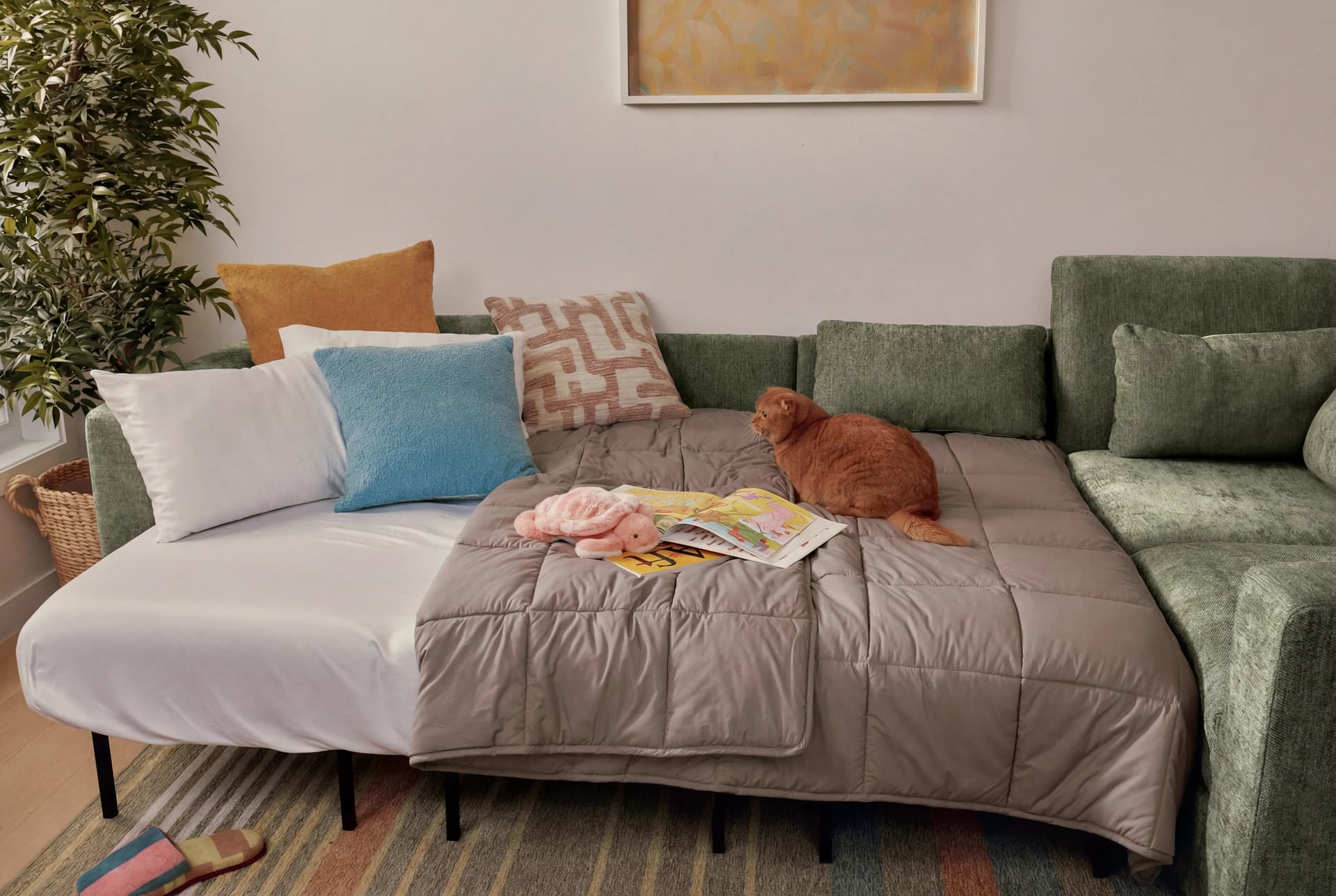
Short answer: Neither mechanism is the better choice for all homes. As a general rule, a pull-out sofa bed stores a separate mattress inside the frame and extends it into the room, while a fold-down sofa bed tips the back flat so the cushions become the bed. Pull-outs tend to feel more like a mattress but take more effort, and fold-downs are quicker but you sleep on the sofa itself. Our Neptune, Orian and Atmosphere Sleeper work differently from both: each sleeper seat opens on its own, in about 10 to 20 seconds, with no tools.
A sofa bed has to do two jobs, and the mechanism decides how well it does the second one. It affects how the bed feels, how hard it is to open at 10 pm with a guest waiting, and how much floor you need. This guide explains both mechanisms, then shows where our three sleepers fit.
On This Page
- How does a pull-out sofa bed work?
- How does a fold-down sofa bed work?
- Pull-out vs fold-down at a glance
- Which sleeps better: pull-out or fold-down?
- Which is easier to convert?
- Where do Neptune, Orian and Atmosphere Sleeper fit?
- What to check before you choose
- Our recommendation
- Explore our sofa beds
How does a pull-out sofa bed work?
In a typical pull-out, a mattress folded in sections sits inside the base of the sofa. You remove the seat cushions, lift a handle and pull a metal frame forward until it unfolds into a full bed on short legs. This is general advice about how the type usually works, not a product specification, and individual models vary.
The appeal is a sleeping surface that is separate from the seating cushions, so it can feel closer to a mattress. The trade-offs are also familiar. The frame can be heavy to pull out, the folded mattress is often thinner than a regular one, and the bed needs room to extend into the room. The mattress also takes up the space inside the base, so there is usually little room left for storage.
How does a fold-down sofa bed work?
A fold-down sofa bed uses the sofa's own seat and back. The backrest is released and tips back until it lies flat and level with the seat, and the two cushions together become the sleeping surface. Many models are a single motion with no heavy frame to pull out.
That simplicity is the main advantage. The trade-offs are that you sleep on cushions designed for sitting, there is usually a seam where the seat meets the back, and the open bed is often only about the size of the sofa. Some models need a little clearance behind them while the back moves, so check the instructions for any model you are considering.
Pull-out vs fold-down at a glance
These are typical patterns, so treat them as a starting point rather than a rule.
Pull-out vs fold-down at a glance
| Question | Pull-out | Fold-down |
|---|---|---|
| What you sleep on | A separate folded mattress stored in the base | The sofa's own seat and back cushions laid flat |
| How it opens | Remove the cushions, then lift and pull a frame forward | Release the back and tip it flat |
| Effort | More lifting, often a heavier frame | Often one motion |
| Floor space | Extends into the room | Often a smaller footprint, depending on how the back moves |
| Sleeping feel | Mattress-like, but the mattress is often thin | Cushion-based, with a seam between seat and back |
| Storage | The mattress takes up the base | Space under the seat can sometimes be left free |
Which sleeps better: pull-out or fold-down?
The mechanism matters less than what you end up lying on. As a general guide, check four things on any sofa bed: how thick the sleeping surface is, how firm it is, how many seams you would feel, and how well it is supported underneath. A thin pull-out mattress with a bar under it can be less comfortable than a thick fold-down cushion, and the reverse can also be true.
Our modular sleepers sit between the two. The bed is made from the seat and back cushions, so there are joins, and we build the foam in layers to keep the surface consistent from head to foot. Neptune and Orian use about five inches of layered foam and feel firm. Atmosphere Sleeper uses about eight inches and feels softer. Our Sleep Kit adds a mattress topper that cushions the surface and helps hide the joins. For a longer look at sitting and sleeping comfort, read are our sofa beds comfortable.
We do not recommend any of our sleeper sofas as a permanent, nightly replacement for a mattress. Our guide to sleeping on a sofa bed every night explains why.
Which is easier to convert?
In general, fewer steps and less lifting make a sofa bed easier to use. A pull-out asks you to clear the cushions and pull a frame, and a fold-down asks you to tip the back and find somewhere for any loose cushions. Either one is harder if a coffee table is in the way.
Our three sleepers are designed to be opened by one person without tools. Because each sleeper seat opens separately, you can open one seat as a lounging spot and leave the rest of the sofa closed.
- Neptune: lift and pull the seat forward, the supporting legs unfold automatically, then pull the backrest forward to complete the bed. About 20 seconds per seat.
- Orian: pull the fabric lever behind the sleeper seat, the seat unfolds and the legs deploy, then the backrest folds forward. About 20 seconds per seat.
- Atmosphere Sleeper: release the Velcro-secured sleeper sections and unfold them onto the floor. About 10 seconds per seat.
Whatever you own, take the sheets and topper off before you close the sofa. Our guide to cleaning and maintaining a sleeper sofa covers this and the care of the moving parts.
Where do Neptune, Orian and Atmosphere Sleeper fit?
None of our sleepers is a classic pull-out with a hidden mattress, and none is a classic fold-down. Each is built from modules, and the bed is made from the seat and back cushions of those modules. Here is how the three compare.
Where do Neptune, Orian and Atmosphere Sleeper fit?
| Collection | How it converts | Time per seat | Bed height | Sleeping foam | Bed size |
|---|---|---|---|---|---|
| Neptune | Lift and pull the seat forward, legs unfold, pull the backrest forward | About 20 seconds | Raised on legs | About 5 inches, firm | Three-seater: Full, 56.7 x 75.6 inches (144 x 192 cm) |
| Orian | Pull the fabric lever, seat unfolds, legs deploy, backrest folds forward | About 20 seconds | Raised on legs | About 5 inches, firm | Two seats: Queen, 62 x 80 inches (157 x 202.5 cm); one seat: 31 x 80 inches (78.5 x 202.5 cm) |
| Atmosphere Sleeper | Release the Velcro-secured sections and unfold them onto the floor | About 10 seconds | On the floor | About 8 inches, softer | Three seats: about 225 x 150 cm (about 88.6 x 59.1 inches) |
In how they use space, Neptune and Orian are closer to a pull-out, because the bed reaches forward into the room on legs. In what you sleep on, they are closer to a fold-down, because there is no separate mattress hidden inside. Atmosphere Sleeper is different again, because its sections rest directly on the floor.
Open depth is what changes the room plan: a Neptune three-seater sleeps across its width and reaches the least into the room, while a Neptune two-seater with ottomans and an Orian reach about 80 inches. The table above gives the bed sizes, and the checklist below links to the full open depths.
Storage differs too. Each Neptune sleeper seat has a compartment, which can hold the Sleep Kit, while Orian sleeper seats do not include storage; our guide to sofas with hidden storage maps where each collection keeps it. For the full side-by-side, read Neptune vs. Orian vs. Atmosphere Sleeper, or the single-product guides for Neptune, Orian and Atmosphere.
What to check before you choose
Whichever mechanism you prefer, plan for the sofa in both shapes.
- Open footprint: measure the depth of the open bed, not just the closed sofa. Our guide to how much space a pull-out sofa bed needs walks through a floor mock-up.
- Where things go: decide where the coffee table and any loose cushions will sit at night.
- Who sleeps there: a raised bed is easier to get out of for older guests, and a floor-level bed is quicker to open. Our sofa bed sizes guide helps with sheets and bed sizes.
- How often: for regular overnight guests, comfort and ease of opening matter more than the closed footprint.
If you would like help with your room, you can book a free design consultation.
Our recommendation
Choose by room and by guest rather than by label.
- A wide room with limited depth: the three-seater Neptune, which extends 61.4 inches (156 cm) from the back of the sofa.
- A compact sofa with a Queen bed: a two-seat Orian, 72.8 inches (185 cm) wide when closed and 62 x 80 inches (157 x 202.5 cm) open.
- Bedding stored inside the sofa: Neptune, where each sleeper seat has a compartment.
- The quickest conversion and a softer bed: Atmosphere Sleeper, about 10 seconds per seat on about eight inches of foam.
- Guests who find low beds hard to get out of: Neptune or Orian, which sit on legs.
If you are weighing a traditional mechanism against ours, the real question is the open footprint and the surface you will sleep on. Compare those numbers first.
Explore our sofa beds
Product specifications can change. Check the current dimensions on the product page before ordering.