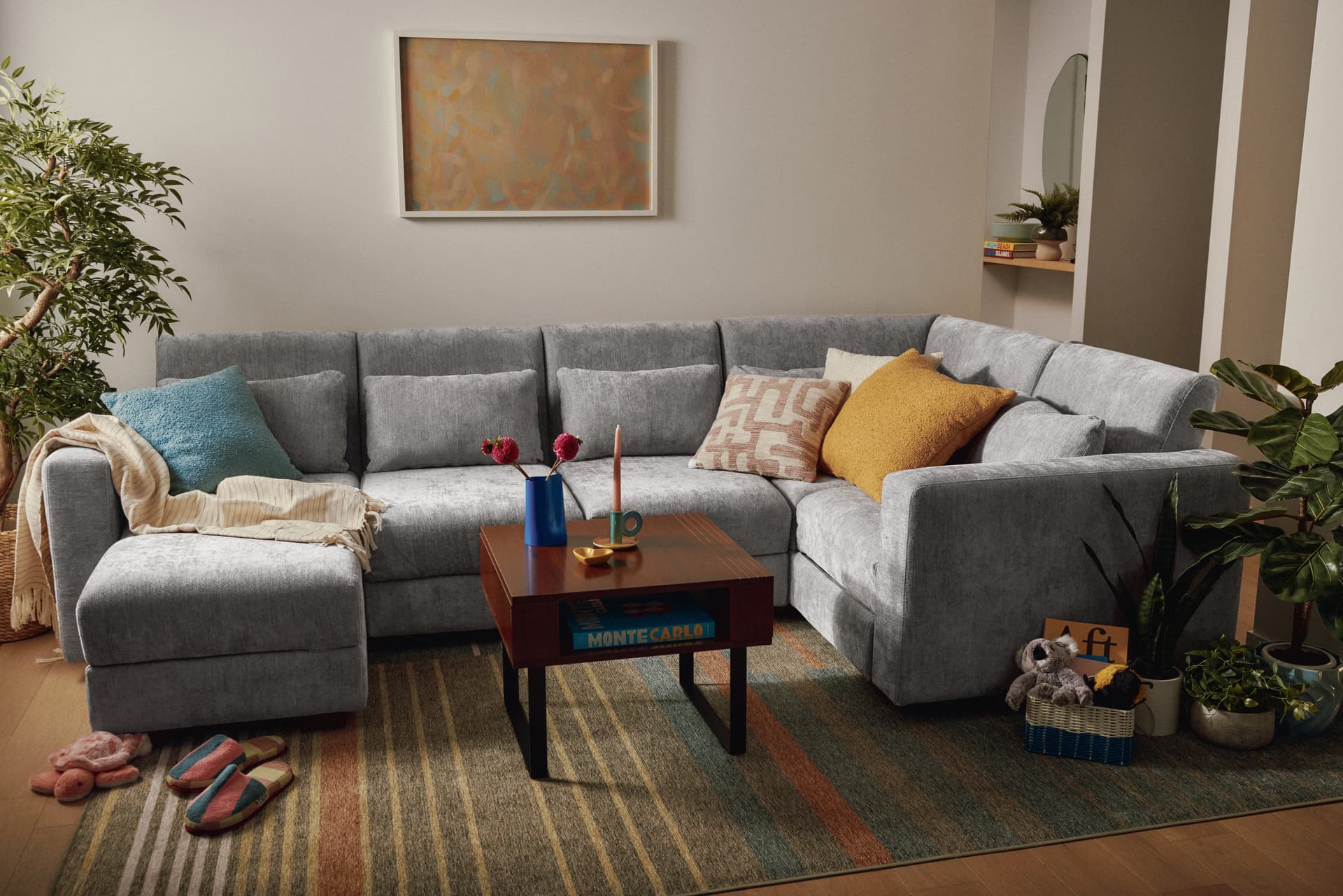
A modular sofa is a seating system made up of individual sections that connect together to form a larger piece. Unlike a traditional sofa or fixed sectional, a modular configuration can be changed: sections can be added, removed, or rearranged to suit a different room or a different need. The term covers everything from a simple two-piece sofa with a chaise to a large U-shaped sectional that wraps around a full living room wall.
Modular sofas vs traditional sofas
A traditional sofa is a single fixed unit. It comes in a set size, ships fully assembled or in a few large pieces, and sits in the same configuration for its entire lifespan. If you move to a smaller apartment, the sofa either fits or it does not.
A modular sofa works differently. Each section, whether a seat module, a corner piece, an armrest, or a chaise, is an individual unit that connects to the others. The overall shape and size of the sofa is determined by how many modules you combine and in what order.
This has practical benefits. You can start with a smaller configuration and add modules over time as your household grows. You can reconfigure the layout if you move to a different space. And because the modules ship and arrive as separate pieces, delivery and installation are easier, particularly through narrow hallways, stairwells, or tight apartment entries where a full-size fixed sofa would not pass.
Cozey's entire seating range is built on this modular system. Sections clip together without tools, which means assembly does not require specialist help and reconfiguration later is straightforward.
Configuration options: L-shaped, U-shaped, and straight
The most common modular configurations are the straight sofa, the L-shape, and the U-shape. Each suits a different room size and use pattern.
L-shaped sectional
The L-shape is the most common sectional configuration. One run of seating extends along a wall; a shorter return or chaise extends at a 90-degree angle. It anchors a living room effectively without requiring a very large footprint, and the corner section creates a natural spot for lounging.
L-shaped sectionals work in most mid-size rooms and are the default choice for apartment and condo living rooms where space is limited but seating capacity matters. For guidance on how to fit one into your space, see how to measure for a sectional.
U-shaped sectional
A U-shaped configuration wraps seating around three sides of a space. It maximises seating capacity and creates a strongly defined social zone, but it requires significantly more floor space than an L-shape.
U-shaped configurations suit larger living rooms, open-plan spaces, or households where the sofa is the primary gathering point for a larger number of people.
Straight with chaise
A straight sofa with a chaise extension is a hybrid option between a standard sofa and an L-shape. It adds a lounging section without the full footprint of a corner module. This is a practical option for rooms that are too narrow for an L-shape but where you still want extended seating.
Adding modules over time
One of the functional advantages of a modular system is that it is not a fixed commitment at the point of purchase. If your household size increases, or if you move to a larger space, you can order additional modules to expand the configuration.
This changes the buying calculation. Rather than trying to anticipate your future needs and potentially overbuying, you can start with the configuration that fits your current room and extend it later. The Ciello sectional and other Cozey collections are designed with this in mind: the connecting system is consistent across modules, so pieces ordered later integrate with the original sofa.
Choosing the right configuration for your space
A few practical considerations when deciding on a configuration:
Room shape: Rectangular rooms generally suit an L-shape along one wall. Square rooms can handle a U-shape if the floor area is sufficient. Narrow rooms suit a straight sofa with chaise over a full L-shape.
Traffic flow: The open side of the sectional needs at least 36 inches of clearance for circulation. A U-shape closes off more of the room, so it needs more total floor space to maintain comfortable walkways.
Household size: A straight two- or three-seat sofa with chaise works for one or two people. An L-shape comfortably seats three to four. A U-shape suits four or more as a primary seating arrangement.
Future flexibility: If there is a reasonable chance you will move within a few years, a reversible chaise and a modular system that can be reconfigured gives you more options than a fixed sectional tied to your current layout.
Once you have a configuration in mind, the next decision is upholstery. See choose your fabric for a comparison of the available options by durability, texture, and household suitability.