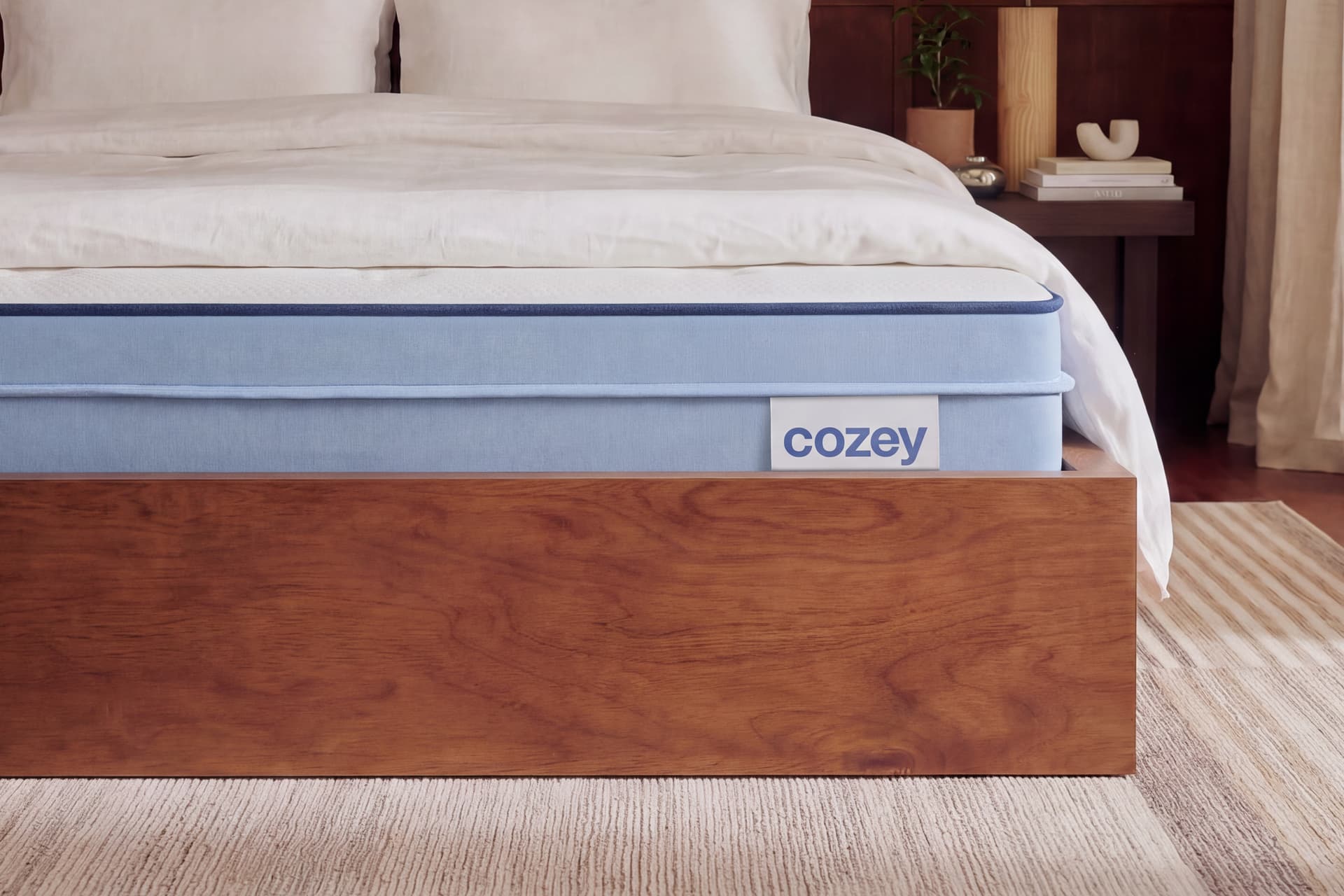
Neither is better across the board. A foam mattress is better if you want stillness, motion isolation and a lower price. A hybrid is better if you sleep hot, change positions a lot or want firm edges. Both can be excellent, and both can be poorly made. The quality of the materials matters more than the category.
We make one of each, so we don't have a reason to push you toward either. This guide explains what actually separates the two, which one suits different sleepers, and the questions that usually settle the decision.
On This Page
- What's the Difference Between a Foam and a Hybrid Mattress?
- Foam vs. Hybrid at a Glance
- How They Compare: Feel, Temperature, Motion, Edges and Durability
- Which Is Better for Your Sleep Style?
- Price, Weight and Other Practical Differences
- How to Decide
What's the Difference Between a Foam and a Hybrid Mattress?
Summary: It comes down to the support core. A foam mattress uses dense foam all the way down. A hybrid puts the same kind of comfort foam on top of a layer of individually wrapped coils.
Most modern mattresses are built in three zones, and the top two are often similar in foam and hybrid models:
- Comfort layer: The top few inches you actually feel. Usually memory foam, standard polyurethane foam, latex or a specialty foam.
- Transition layer: A slightly firmer foam that stops you from sinking straight through to the support.
- Support core: The base that holds your body up and keeps your spine aligned.
Foam mattress
Every layer is foam. The support core is a thick slab of high-density foam, usually 6" or more. It absorbs movement and pressure evenly, so the bed feels solid, quiet and still.
Hybrid mattress
The support core is a layer of pocketed coils: steel springs each sewn into their own fabric pocket so they move independently. Comfort foam sits on top, and many hybrids add a foam border around the coils for edge support. The coils add bounce and leave open space for air to move through.
Hybrid vs. innerspring
A hybrid isn't the same as a traditional innerspring mattress. Older innersprings use connected coils with a thin padded top, so movement travels across the bed and you feel more of the springs. A hybrid has individually wrapped coils and a real comfort layer of several inches, which gives it far better pressure relief and motion isolation.
Foam vs. Hybrid at a Glance
Foam vs. Hybrid at a Glance
| Foam mattress | Hybrid mattress | |
|---|---|---|
| Feel | Close, cradling, you settle into it | Lifted, springy, you sit more on top |
| Motion isolation | Excellent | Good |
| Bounce | Low | Medium to high |
| Airflow and temperature | Fine, depends on the foam | Better, air moves through the coils |
| Edge support | Softer edges | Firmer edges, especially with a foam rail |
| Noise | Silent | Near silent with wrapped coils |
| Ease of moving around | Takes a bit more effort | Easier |
| Weight | Usually lighter | Usually heavier |
| Price | Usually lower | Usually higher |
| Best for | Couples, light sleepers, side sleepers who like a hug | Hot sleepers, combination sleepers, edge sitters |
How They Compare: Feel, Temperature, Motion, Edges and Durability
Feel
On a foam mattress, you settle into the bed and it stays put around you. On a hybrid, the coils push back as you move, so you feel lifted and changing positions takes less effort. With the same comfort layer, a hybrid also tends to feel a touch firmer. Our Hybrid sits around 6 to 6.5 out of 10 and our Foam Mattress around 5.5 to 6, with identical top layers.
Temperature
Hybrids have the edge here. The open space in a coil layer lets air move through the mattress, which a solid foam core can't do. But the comfort foam matters too. Traditional memory foam holds heat and softens with body temperature, which is where foam's "sleeps hot" reputation comes from. Foams that aren't heat sensitive, like the Serene® foam we use, release heat faster. If you run very hot, a hybrid is still the safer bet.
Motion isolation
Foam wins. A dense foam core absorbs movement instead of passing it along, so a partner rolling over or getting up is barely noticeable. Individually wrapped coils isolate motion far better than an old innerspring, but you'll still feel a little more bounce than on foam.
Edge support
Hybrids usually win, especially ones with a firm foam rail around the coils. That matters if you sit on the edge of the bed to get dressed, or if two people share a smaller bed and use the full width. Foam edges compress more under concentrated weight.
Durability
Both can last 10 years or more if they're well built. For foam, density is what decides it: high-density support foam holds its shape, low-density foam breaks down and sags. For hybrids, coil quality and the comfort foam on top are what wear first. Either way, look at the warranty's indentation threshold. A 15-year warranty that only covers sagging deeper than 1.5" or 2" protects you less than one that covers 1".
Which Is Better for Your Sleep Style?
Summary: Hot sleepers, combination sleepers and heavier people usually do better on a hybrid. Light sleepers and couples who wake easily usually do better on foam. Side and back sleepers can be happy on either.
Which Is Better for Your Sleep Style?
| If you... | Usually better | Why |
|---|---|---|
| Sleep hot | Hybrid | Air moves through the coil layer |
| Share a bed and wake easily | Foam | Absorbs the most motion |
| Sleep on your side | Either | What matters is a comfort layer that relieves shoulder and hip pressure |
| Sleep on your back | Either | What matters is medium to medium-firm support under the lower back |
| Sleep on your stomach | Hybrid | Holds the hips up better, so your back doesn't arch |
| Change positions a lot | Hybrid | Bounce makes moving easier |
| Sit on the edge of the bed | Hybrid | Firmer edges |
| Weigh over 230 lb | Hybrid, often a thicker one | Coils add support under heavier loads |
| Like a hugged, sink-in feel | Foam | Contours more closely |
| Want the lowest price | Foam | Fewer components, usually cheaper |
A note on back pain: firmness and support usually matter more than whether a mattress is foam or hybrid. If you have ongoing back pain, it's worth asking a doctor or physiotherapist what they'd recommend for you.
Price, Weight and Other Practical Differences
Price. Hybrids usually cost more because coils add material and manufacturing steps. With the same comfort layers, our Hybrid is $200 more than our Foam Mattress in every size: $895 vs. $695 for a Queen.
Height. Hybrids tend to be taller. Ours is 12" vs. 10" for the Foam Mattress, so check your fitted sheets have deep enough pockets.
Weight. Steel coils add weight. A Queen Cozey Hybrid ships in a 70 lb box, compared with 62 lb for the Foam Mattress. Both arrive rolled in a single box with a handle.
Base. Both work on a platform, slats, a box spring or the floor. Either way, Queen and King sizes need center support, and slats should be no more than 3" apart.
Care. The routine is the same: rotate head to foot every few months, don't flip a one-sided mattress, and use a protector to keep the cover clean.
How to Decide
Most people can settle it with three questions:
- Do you sleep hot? If yes, lean hybrid.
- Does your partner's movement wake you up? If yes, lean foam.
- Do you change positions a lot or sit on the edge of the bed? If yes, lean hybrid.
If none of those apply, go with the feel you prefer: sinking in slightly (foam) or lying on top (hybrid). And whichever you pick, buy from a brand with a real sleep trial, so you can switch if you guessed wrong.
How we make both at Cozey
We use the same 2" Serene® comfort layer and 2" transition foam in both of our mattresses, so the only real difference is the core. The Cozey Foam Mattress puts it over 6" of high-density foam. The Cozey Hybrid puts it over 6" of individually wrapped pocket coils, about 1,200 in a Queen, with a foam edge rail. Both are medium-firm, made in Canada, and come with a 100-night trial and a 15-year limited warranty. During the trial, you can exchange one for the other.
For what it's worth, I sleep on the Hybrid, and it's been our most popular mattress since we launched it. But I'd send a light sleeper who shares a bed straight to the Foam Mattress.